
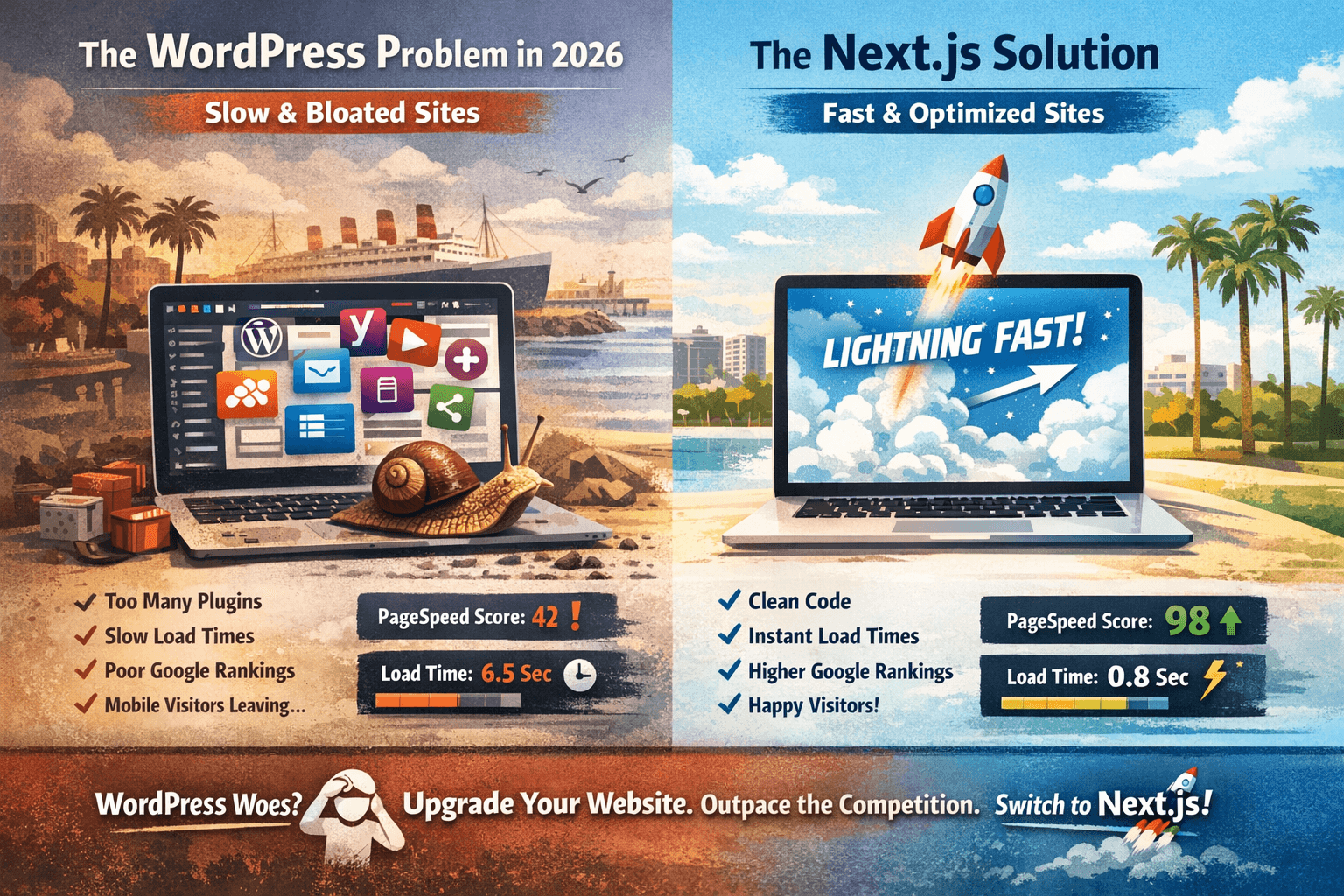
If you're a small business owner in Long Beach running a WordPress site, you might not realize your website is actively working against your marketing efforts. Not because WordPress is fundamentally broken—it's not—but because the way most WordPress sites are built in 2026 creates slow, bloated websites that Google penalizes and potential customers abandon.
This isn't about trashing WordPress. It's about understanding when the platform that once made sense for your business is now holding it back, and what alternatives like Next.js offer for businesses serious about online performance.
The Real WordPress Problem: Death by Plugin
WordPress itself isn't slow. A bare WordPress installation loads quickly. The problem is that nobody runs bare WordPress.
The typical Long Beach small business WordPress site looks like this:
- Page builder (Elementor, Divi, WPBakery) — adds 500KB+ of CSS/JS
- SEO plugin (Yoast, Rank Math) — adds processing overhead
- Contact form plugin — another 200KB
- Caching plugin (trying to fix the slowness)
- Security plugin
- Analytics plugin
- Social sharing plugin
- Slider plugin
- Gallery plugin
Each plugin adds JavaScript, CSS, database queries, and HTTP requests. By the time your homepage loads, you're serving 3–5MB of data with 100+ HTTP requests. Your "mobile-friendly" site takes 8 seconds to load on a phone.
Google's Core Web Vitals don't care about your intentions. They measure actual performance, and plugin-heavy WordPress sites routinely fail.
The Hidden Cost
When your site loads slowly:
- Google ranks you lower in search results
- Mobile users hit the back button within 3 seconds
- Your ad spend is wasted driving traffic to a slow site
- Potential customers assume your business is outdated
You're not just losing rankings. You're losing customers who never even see your content.
What Most Long Beach Businesses Get Wrong
"But my developer said it's optimized"
Your developer installed:
- WP Rocket (caching)
- Smush (image optimization)
- Cloudflare (CDN)
Your site still scores 40/100 on PageSpeed Insights.
Why? Because these tools can't fix fundamental architectural problems. You're optimizing bloat, not eliminating it. It's like putting racing stripes on a minivan.
"I need those plugins for features"
Do you, though?
- Contact forms? A Next.js site handles forms with 50 lines of code, not a 2MB plugin.
- SEO? Modern frameworks generate clean HTML that Google prefers. No plugin needed.
- Image optimization? Built into Next.js natively.
- Analytics? One script tag. Not a plugin.
Most WordPress features you "need" are solving problems WordPress created.
"But WordPress is good for SEO"
WordPress was good for SEO when it was the only option for non-developers. In 2026, it's a liability.
Google cares about:
- Speed — WordPress loses
- Mobile performance — WordPress loses
- Clean code — WordPress loses
- Core Web Vitals — WordPress loses
The only reason WordPress sites still rank is because many competitors also use WordPress. But modern sites built with Next.js, Astro, or similar frameworks load in under a second and dominate search results.
What Modern Frameworks Actually Offer
Next.js (and similar frameworks) solve the core problem
Instead of:
- Loading a PHP framework
- Querying a database on every page load
- Loading dozens of plugins
- Rendering HTML server-side on demand
Modern frameworks:
- Pre-render pages at build time — no database queries needed
- Serve static HTML — loads instantly
- Only load JavaScript you actually need — no bloat
- Optimize images automatically — no plugin required
- Handle routing, forms, and features in code — no dependency hell
Your entire site can be 500KB instead of 5MB. It loads in 0.8 seconds instead of 8.
Real-World Long Beach Example
A local contractor we worked with was running WordPress + Elementor:
- Before: 6.2-second load time, PageSpeed score 38
- After (Next.js): 0.9-second load time, PageSpeed score 98
Same design. Same content. Different foundation.
The result? Their organic traffic increased 140% in 4 months. Not because of "better SEO tactics," but because Google started actually ranking them higher, and visitors stopped bouncing immediately.
When WordPress Still Makes Sense
To be fair, there are scenarios where WordPress remains the right choice:
- You need non-technical team members to edit content daily (though modern CMSs like Sanity or Contentful solve this too)
- You're running a complex membership or e-commerce site (WooCommerce ecosystem is mature)
- You have an existing site with 1,000+ posts and migration isn't feasible yet
But for most small businesses—contractors, restaurants, professional services, local retailers—WordPress is overkill that backfires.
The Migration Reality
Switching from WordPress to a modern framework isn't "starting over." It's:
- Exporting your content (automated)
- Rebuilding your design in clean, fast code (1–2 weeks for most sites)
- Deploying to modern hosting (Vercel, Netlify) — often free or cheaper than current hosting
- Maintaining the site with less technical debt going forward
Most Long Beach businesses spend more time fighting WordPress plugin conflicts in a year than a one-time rebuild would cost.
What This Means for Your Business
If you're running a WordPress site and:
- Your PageSpeed score is below 70
- Your mobile experience is slow
- You're paying for SEO but not seeing results
- Your bounce rate is high
- You're constantly updating plugins and fixing conflicts
Your website platform is sabotaging your marketing.
The question isn't "Can we optimize WordPress?" It's "Why are we optimizing a system designed for 2010?"
The Next Step
Modern web frameworks like Next.js aren't experimental. They're what large companies, high-traffic sites, and performance-focused businesses already use.
For Long Beach small businesses competing online, the difference between a WordPress site and a modern framework isn't academic. It's the difference between:
- Ranking #8 or #2 in local search
- Losing 50% of mobile visitors or converting them
- Spending $500/month on hosting and plugin licenses or $0
- Fighting technical debt or building on a solid foundation
If your business depends on your website—and in 2026, it does—your platform matters more than ever.
Your competitors are already making the switch. The question is whether you'll wait until it's too late.
Ready to see what a modern, fast website could do for your business? Learn more about our web design approach or get a free performance audit of your current site.